Most of these appear in the app without explanation. If a term in an answer above was unfamiliar, it is here.
- Credit
- The unit plans, packs and overage are measured in. One credit = one hour of Standard analysis; a Studio hour costs two.
- Pass
- The single analysis run made over a file on ingest — transcript, scenes, tags and story notes all at once. There is no second pass to schedule.
- Ingest
- Reading footage from a folder or connected drive into a project. Runs in the background and resumes if the drive disconnects.
- Scene
- A story beat Scenehand cuts a file into. Search results, citations and comments all attach to scenes rather than whole files.
- Scene card
- The scrubbable thumbnail a scene appears as in search and browse. Hover to preview without opening the file.
- Citation
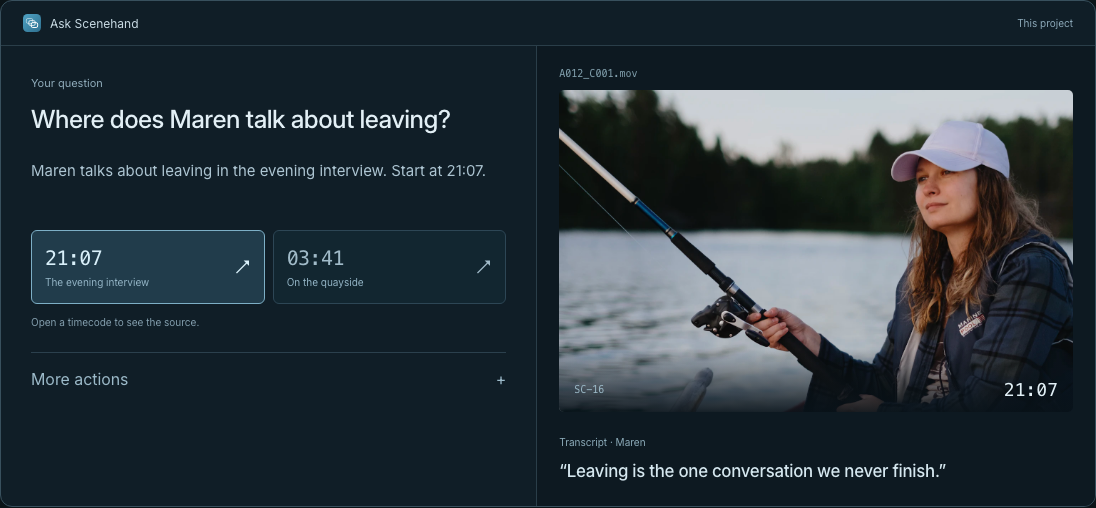
- The scene and timecode attached to every Ask answer and Story claim, so it can be played and checked rather than trusted.
- NOT SURE
- What Ask says when the footage cannot support a confident answer. It is never a guess.
- Ask
- Plain-language questions across a project, a file or a scene, answered with citations.
- Story
- The people, themes, locations, arc and soundbites Scenehand reads out of a project before you watch a frame.
- Soundbite
- The strongest quotable line in a scene, timecoded and attributed to a speaker.
- Shot size
- Wide, medium, close-up and their variants, detected per scene and available as a filter.
- Roll
- A-roll is primary interview or action; B-roll is supporting coverage. Detected automatically and shown in Insights.
- Tag library
- The shared, project-wide set of tags — automatic and your own — that the whole team filters on.
- Proxy
- A lightweight local copy the desktop app generates so scrubbing is instant. Optional, and never counted as a duplicate.
- Seat
- A billed member who can change content. Viewers browse, search, ask and comment for free, without limit.
- Channel
- Stable or Beta — which desktop-app releases you receive. Switch in the update panel.